Showing posts with label zappa. Show all posts

Friday, January 23, 2009

Black Page Marimba Attempt

So as I said, I have a marimba in my office and, since I can already play the drumset part for Frank Zappa's The Black Page, I decided to tackle the mallet part as well. Far easier said than done. This is my first try and it is indeed far from perfect, but worth documenting. I'm working the same way I did with the drum part. Generally, for the first time through, I will ignore the complex phrasing and just try to get the pitches and sticking right, then I can practice with a metronome and get the polyrhythms rhythmically correct. So when you listen to this keep in mind that I'm just sort of playing the rhythm by ear. I'm also ignoring the rolls. All I want this first time through is to get the pitches and sticking down. This is approximately the first six measures of the piece.

P.S. that's not a video, just an MP3 with a static picture attached. Not even my hands.

Wednesday, January 21, 2009

Black Page Update

"That's right folks, don't touch that dial". I'm gonna try to keep you updated through this just like I did last year. Step by boring step! Unh-Hunh, the resolution for 2008 was to finally play The Black Page on the drum set and I succeeded, even playing it live before an audience of five or six drunken twits in a dive bar in Scottsdale, Arizona.... GOSH I'm proud of myself. The res for 2009 is to play the mallet part. Yes, since I'm now officially a music teacher, I have a marimba in my office and, by God, I'm gonna play that damn thing. Every morning I have about twenty minutes and every afternoon I've got my prep hour. I'm devoting that time to The Black Page. Presently, I can play the first four measures. I contacted Zappa percussion alumnnus Ed Mann through MySpace.com to ask for advice and he was kind enough to give me this sage wisdom... "*) transpose where necc.*) play with whichever mallet grip feels best to you* ) use normal methods (math) to conjugate polyrhythms and create a worksheet if necc to mark the subdivisions of the meter, that's what I did - it seemed to work. good luck Ed Mann". Thanks Ed! So, at this point I'm up to measure five. I'm very confident that I'll be able to complete this. Special thanks to Keith for the vibes so I can practice at home too.

Tuesday, January 20, 2009

More Black Page

So, now that I can play the drum part for The Black Page, I've decided to tackle the mallet part. The transcription I have is for keyboard melody, so I'll have to compare it to a recording to figure out if there are any quirks I need to be aware of. The score is from an old copy of Keyboard Magazine. I'm playing it on marimba and I would love any tips if anyone's got some.

Saturday, March 22, 2008

I Did It

I did it
I did it
I really
really did it
I said that I would do it

and indeed I did!
My New Year's resolution was to finally play The Black Page. Well, by golly last night I did it. I played The Black Page live flawlessly... for three people who loved it and ten people who drank at the bar and never heard a note. The band that played after us did a halfway decent Slayer cover.

Thursday, March 13, 2008

Zis Guy

Okay, what can I say about this guy? Well, I've just managed to play a piece that I've wanted to play since I was a teenager, and it was written by him. Three of my favorite drummers of all time came from his band. This guy introduced me to Edgard Verese, Arnold Shoenberg, Pierre Boulez, Igor Stravinsky, Johnny Guitar Watson, The Tuvan Throat Singers, Flo and Eddy, Captain Beefheart, the Brecker Brothers, Eddie Jobson, Adrian Bellew, the Bulgarian Women's choir, Terry Bozzio, Warren Cucarrulo, Chad Wackerman, Steve Vai, Mike Keneally and who knows who else? I have more albums by this artist than any other. I owe this guy a real debt of gratitude. He is a true genius of music.

Wednesday, March 12, 2008

The Whole Score

Okay, okay, okay.... one more. Here's the whole thing as I copied it from the Bozzio video. I just thought that, as I've shown individual measures here and there, I ought to post the whole score that I've been working from. Personally, I think scores are marvelous to look at. it doesn't look like much in that tiny image but, if you click on it, it will open in a new window and you can enlarge it at will. Yes... you can enlarge it if you want to.

Monday, March 10, 2008

Measure 28


Okay, so here's measure 28 of The Black Page. This is the last really tough bit, measure 29 is just an open roll on the floor tom. Anyway, I've worked this out and it isn't really as difficult I thought it would be given that I've already gotten the nested tuplet figure and the undecuplets down. I really focussed on it today and I worked out all the sticking, so now it's just a matter of practicing it with the rest of the piece. That said, I think I will refrain from posting on this subject again until I can present a video.
P.S. Frank and Eliot have both said they want me to play it live, so this will be popping up in a set some time soon. It will be our one and only cover.

Tuesday, February 19, 2008

Yes!

Hooray for me... Hooray! I finally managed to play measure twenty-six of The Black Page. The method I outlined below in the post titled "Driving Me Mad", has worked beautifully. That leaves only two measures. Measure twenty-seven is just a triplet (thanfully actually only three notes in it this time) over a half note, then a half note roll. Measure twenty-eight on the other hand is rather a bugger consisting of a slight variation on the half-note-triplet-nested-polyrhythm-thing and two undecuplets. Since I've already learned how to play very similar figures in the previous measurs, I think this will be downhill from here. There is, by the way, a measure twenty-nine, but it's just a roll and hardly worth mentioning.

Saturday, February 16, 2008

Driving Me Mad

Well, here we are back at measure 26! I can play the entire Black Page except these last few measures. Okay, so how do you tackle something like this? Here's my approach. First, I'm going to ignore the time signiture and the tuplets. I'm just going to think of this as a string of 16ths. I'll just work out the sticking and play everything evenly spaced. The next step will be to nail the timing. I think the thing to do here is to imagine every note as writtin on the snare drum line. Tap my foot and try to just play all of the notes like a march (so to speak). I think if I can go back and forth between these two ideas, in a short time I'll be able to put them together.

Wednesday, February 13, 2008

Black Page Update

Okay, so Andy want's to know where I am with The Black Page. Well, I am pretty much about where I was the last time I posted! I have three measures left to learn and it's really slow goin'. I've just been working through measure 26 trying to work out the sticking first. Once I know what to hit with which hand when, I will start to actually work with the metronome to get the tuplets down. This is gonna take a while, so bear with me. I have a family, a full time job plus 14 students, six college credit hours, and a band to write for and rehearse. I get about 15 minutes a day to work on this thing. I will not be ready to play it at this Friday's show.

Sunday, January 27, 2008

Progress Report

Well it's been a month now and I am extremely pleased by my progress with The Black Page. I can play it smoothly through measure twenty-five. That leaves only three measures (albeit very difficult ones) but I have every confidence that I will be able to master them. It's tempting to post a recording of it so far, but I'm resisting. I'm so close that I might as well just finish and post it in it's entirety. I've played what I have so far for the guys in my band and they've agreed that I should play it at our gigs, so I may have a live video at some point. Also, one of my better students has taken quite an interest. I've taught her the first three measures and she's up for learning more. Bless her little heart.

Friday, January 18, 2008

The Error of My Ways

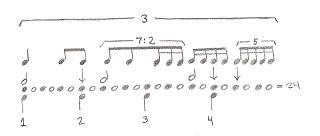
First of all, special thanks to Kevin Johnson for providing the key to deciphering measure fifteen. As you no doubt read in previous posts, I was completely confused by measure fifteen of The Black Page. The big puzzle for me was, how do you have five quarter note length figures in a measure of 4/4 time and call it a triplet? I had guessed that the 7:2 septuplet on beat three was probably a clue. I then said that I would practice playing a triplet over a measure of 4/4 and hope that would give me some clue. Well, as it turns out, I was on the right track but had one serious flaw in my approach. For some reason I kept thinking my triplet was three quarter notes over the 4/4. Kevin said hey, are you sure it isn't three half notes? That would equal six quarter notes. Then the 7:2 would mean that the septuplet is spread over two quarter notes. You have two quarter notes on the first beat of the triplet, a septuplet over two quarter notes on the second beat of the triplet, and two more quarter notes on the last beat of the triplet. Voila - five quarter note length groups over a measure of 4/4 time, counted as a triplet, and the 7:2 makes sense. Thank you Kevin! For those who didn't follow that (Andy), here's a diagram that may help (it helped me):To begin with, I said I'm playing a triplet over four downbeats and I want to try and see where all those notes line up in relation to each other. The first thing I'm going to do is find a common denominator between the 3 and the 4. In this case, since I have 5(6) quarter note groups to account for in my triplet, I'm going to multiply 6x4=24. Now I'll draw twenty-four evenly spaced beats on the page. To find the quarter note downbeat, I put a note stem down on beat one. Now I'll put a note with the stem down on every sixth beat. This should give me four evenly spaced notes - stem down. Next, to find the triplet, I'll put a half note on beat one - stem up. Next, I'll put a half note on every eighth beat. This gives me three evenly spaced half notes stem up. Now, how do the notes of the phrase relate to the twenty-four beats and the quarter note downbeat? Well, the first two items are a quarter note and two eighth notes. That equals two quarter notes, or the first half note of the triplet. Now, lets imagine our twenty-four evenly spaced beats as divided into three groups of eight. Take the first eight and line up your quater and two eighths on one, five, and seven, (think 1e&a 2e&a). Now, the septuplet, it's noted as 7:2. That means it stretches evenly over two quarter notes. Think of this septuplet as 4+3=7. The first two beats of the septuplet are eighth notes, that equals four sixteenths. The second half of the figure is three sixteenths. If you spread them evenly across, the first four sixteenths will fall slightly ahead of the halfway mark and the last three sixteenths will fall just after downbeat three. Now we get to the last beat of the triplet - a group of four sixteenths and a sixteenth note quintuplet. Okay, the interesting thing to note here is that the first four sixteenths start on the last beat of the triplet and the "and" of that group falls right on downbeat number four. There a four beats left in the original twenty-four. Here you're going to whip off a quintuplet, which is easier than it sounds. It actually feels like it's coming on the last "and" of the measure. The overal effect of this phrasing is a sensation that the tempo is speeding up, but the downbeat stays constant.

Monday, January 14, 2008

Measure 26

So, the next rather challenging measure in The Black Page is number twenty-six. Unlike measure fifteen, this one isn't particularly difficult to understand, it's just a little tricky to execute - particularly those two eleven note tuplets on beats three and four. That's a lot of notes crammed into a rather small space.
(a minor digression)
So, what the heck do you call an eleven note tuplet, anyway? I did a bit of searching on line, but nothing seems to list anything beyond septuplet. In frustration, I searched for the names of polygons and found a math website that lists polygon names up to one hundred sides. An eleven sided polygon is referred to as a hendecagon. Okay, bringing it back to music, a ten sided polygon is called a decagon and a twelve sided polygon is called a dodecagon. I believe I have heard a ten note tuplet referred to as a decuplet and a twelve note tuplet as a dodecuplet. With that in mind, my first guess was that an eleven note tuplet would be called a hendecuplet. However, thanks to my good friend kevin Johnson, I can officially tell you that it is an undecuplet. Kevin directed me to http://www.dolmetsch.com/ an online music dictionary.
(back to the point)
As I said, that's a lot of notes crammed into a small space. There is, of course, one very logical way to approach a measure like this: go really slow and use a metronome. By the way, the undecuplet figures are used again in measure twenty-eight which contains the nested polyrhythm from measure five (slightly reconfigured) and two undecuplets on the back end of the measure. I will post more about that one when I get to it.

Moving Right Along

So, as I mentioned in the last post, I've run up against some difficulty with measure fifteen. I have been practicing the triplet across four beats as I said would, unfortunately it hasn't led to any great epiphany. I still don't understand how five quarter notes are to played as triplet across a measure of 4/4 time. That said, I am moving on. In order to continue forward momentum, I have memorized the sticking for measure fifteen and I am just learning it by ear/feel. While this will not open any music theory doors for me, it will allow me to progress with the piece as a whole. Hopefully, things will start to gell as I continue to play and study the measure.

Now, because the piece actually repeats the opening section after measure fifteen, I am able to play up to measure twenty-five. Some sections are smoother than others, but it will even out with practice. I feel like I'm making extremely good progress. The piece is only 30 measures.

Friday, January 11, 2008

Deconstructing Measure 15

In my last post I confessed to being utterly befuddled by measure fifteen of The Black Page. I need to deconstruct the measure and learn it piece by piece. The most prominent element to my eye is the notation that this is a triplet figure played across the entire measure. Now, I mentioned before that it's confusing because the measure contains five quarter note length groupings, but I'm going to ignore that for now and focus on just playing a triplet over four downbeats. As I understand it that will be a 3:4 or "three against four" polyrhythm. On his website, Terry Bozzio gives a formula for working these kinds of figures out. First, I need to multiply three and four to find a common denominator. Three times four equals twelve, so the first thing I'm going to do is write out twelve evenly spaced beats on a page. Next, to find the 4/4 downbeat, I will draw a stem going down from every third beat. This should give me four notes extending downward with two notes between each beat. Next, to find the triplet, I will draw a stem going up from every fourth beat. This should give me three notes extending upward with three notes between each beat.

Now if I tap my foot on the 4/4 downbeat and think of each as a triplet (i.e. ONE two three, TWO two three, THREE two three, FOUR two three), I can easily see where each beat of the larger triplet should fall.

This doesn't answer my other questions regarding this measure, but it is a step in the right direction. For now, I'm going to play the piece and, when I reach measure fifteen, I'm just going to play the triplet on the snare while I tap the downbeat on the hi-hat until it becomes second nature.

Tuesday, January 8, 2008

Measure Fifteen!

Moving along in the continuing saga of my attempt to learn The Black Page, we come now to measure fifteen. I will admit right out that this one is really stumping me. I actually thought that I must have written the figure wrong because it doesn't make sense to me. However, comparison to the melody score taken from Guitar Player magazine shows that this is indeed the way Zappa wanted it to be played. Two things are confusing to me. First, I count five independent quarter note length groups in this measure: one quarter note on beat one, two eighths on beat two, a septuplet on beat three, four sixteenths on beat four, and a quintuplet on beat five. Shouldn't five quarter notes played in one measure of 4/4 time be called a quintuplet? How is this to be played as a triplet? I honestly do not know. The second confusing thing is the septuplet on beat three which is rendered 7:2. This is seven against two. The septuplet is occuring as seven sixteenth notes in the space of a quarter note, so the 2 in 7:2 must be referring to two eighth notes (= 1 quarter note), If this is correct, then why isn't the quintuplet on beat five rendered 5:2? What makes the septuplet different such that it needs additional information other than just a seven over the figure? Am I interpreting 7:2 incorrectly? Is it this 7:2 that somehow makes what appear to be five quarter notes a triplet rather than a quintuplet? What's the meaning of all of this? Who did kidnap the Lindberg baby? Where can I go to get my poodle clipped in Burbank? Where can I go to get organic Vaseline?

Questions, questions, questions flooding the mind of the concerned youth. Ahhh, but it is a great time to be alive... (pointless, esoteric Frank Zappa song quote digression).

Anyway, this is what I'm trying to work out. I admit it, I'm completely baffled at this point. I'm sure that someday, after I've worked this whole thing out, I will be a better person for the effort. Who knows, you may be a better person too! Probably not better than me though.

Those Darn Zappas

Those Darn Zappas. I think that would make a great title for a reality TV program. That notwithstanding, the thrust of this post has more to do with my previous post regarding The Black Page. I am having problems with my score. I've contacted Munchkin Music, the organization that oversees the distribution of Zappa orchestral scores. The Black Page is not listed as being available for purchase or rental and whoever runs the site has not responded to my queries. Furthermore, Gail Zappa sent me a note a few years ago stating that the score was not available at that time. This leaves me with my hand written score taken from the Bozzio/Wackerman video which, quite frankly, contains some ambiguities. For instance, the placement of notes on the staff does not match current standard drumset notation. Everything appears to be shifted down two whole steps, at some points the drummers play rolls on the snare and floor tom that don't appear to noted in the score, and none of the cymbals are specified (i.e. crash1, crash2, ride, china, etc). I've watched the performance and made notes to indicate the changes, but I still can't be certain of the integrity of my score. I do know that I'm very close. As I read it and compare it to the performance, most of it is dead right. I wish, however, those darn Zappas would make an official printed version available.

Monday, January 7, 2008

Musical Dreams

I mentioned that I've been reading Musicophilia by Dr. Oliver Sacks, which discusses the strange ways our brains deal with music. I also mentioned that I've been working on The Black Page by Frank Zappa, a particularly difficult piece of music for the drums. I've been extremely focussed on learning this piece - practicing it several times a day and executing the complicated tuplet passages with a metronome and practice pad. I've watched performances of it on video several times and I've been discussing it with other musicians. It's been on my mind so much that I find I've been dreaming it. When I woke this morning I realized that it had been running through my dreams in various forms. At some points I was playing it, at others I was watching it being performed, and at other points it was playing like a soundtrack in the background of totally unrelated activity. In my dreams it was flawless. I'm certain that, even though my muscles haven't learned the whole thing, my brain has recorded it. I've listened to this piece hundreds of times and heard it live at seven different concerts (five FZ tours and two ZPZ tours).

I wonder what Dr. Sacks would say about that. Was it recorded entirely by my brain long ago, only to be released now by this intense scrutiny? Or was it only partially in my memory waiting to have the gaps filled through actual study and practice? Is the brain a complete recorder or does it throw out things it doesn't completely get to make room for more important things? Personaly, I suspect the brain records and stores every experience. The right key could set any of them free, even things we didn't entirely understand.

Thursday, January 3, 2008

The Black Page

I have set a goal for myself, my New Year's Resolution. I am determined to learn Frank Zappa's "The Black Page #1". I got the Terry Bozzio / Chad Wackerman video Solos and Duets which contains a duet performance of BP1. As the two drummers play the piece, a complete transcription of the score runs across the bottom of the screen in sync with the performance, measure for measure. Using a pencil, manuscript, and my handy pause button, I was able to write myself a copy. Now, armed with the score and two master performers as guides, I am sailing forth to the realm of polyrhythmia.

I tried this once before and got bogged down at measure five. The first four measures were not that difficult for me. These consist of syncopated phrases with some thirty-second note subdivisions and the polyrhythms are relatively simple triplets, quintuplets, and septuplets. Measure five, however, was very difficult for me. The first note is a half note, okay, no big deal. The second half of the measure is broken up into a quarter note triplet. That's easy enough too. The problem is that the triplet is broken down even further with a quintuplet on the first beat, another quintuplet on the second beat, and a sextuplet on the third beat. Steve Vai refers to this as a "nested polyrhythm", a polyrhythm within a polyrhythm if you will. This same figure occurs four times in the score: at measures five, eight, twenty, and twenty-three. I figured if I could crack this nut, I could surely do the whole piece. Well, I am happy to say I finally worked this part out. Hooray! Hooray for Michael!


I did it by just tapping my foot on the down beat (with a metronome) and playing the quarter note triplet on the snare drum. Then I just played five, five, six on the snare drum and tried to land a beat on one of the next measure. Then I played the triplet a few times. Then I played five, five, six again. After a while (quite a while) it began to just fall into place. I have now worked all the way up to measure nine. This leads me to believe that my goal is attainable. There is another nested polyrhythm at measure fifteen but, I think I'm up to it.
If you have any experience with this piece and if you have any advice that might help me get through it, please let me know. Once I have nailed this thing, I will definitely post a video.

Wednesday, November 28, 2007

Polyrhythms In Prog

I was recently viewing a discussion of polyrhthms on a popular Prog forum. One thing I noticed was a lack of consideration that there is more than one concept that goes by that name. One concept of polyrhythm consists of the sounding of two seperate time signitures simultaneously, i.e 5/4 and 4/4. In this example, after five measures of 4/4 and four measures of 5/4 both meters will land together on "one". Many examples of this in Prog music were cited, including songs by King Crimson, Tool, and Meshugga. I love this stuff and it can get really crazy. The measures don't have to be based on the quarter note either. You could just as easily play 13/16 against 7/8, the principle is the same.

The other polyrhythm concept that was not really discussed is the idea of the "tuplet", i.e. triplet, quintuplet, sextuplet, septuplet, etc. This is the case where an odd number of notes is evenly distributed across an evenly divided number of beats, or vice versa. An example is a measure of 2/4 time comprising an even division of two quarter per measure. If I evenly distribute three quarter notes across the measure I have a triplet, or a 3:2 polyrhythm. The trick is to play the triplet and the duplet simultaneously. This is not so dificult with simple polyrhythms like 3:2, 5:2, 5:3, etc, especially if the occurance of the polyrhythm is isolated. You just find that the larger number is played slightly faster than the smaller number. This becomes much more dificult when you have multiple tuplets of varying degrees ocurring in rapid succession. This is the case with Frank Zappa's The Black Page, (a prog masterpiece).

The Black Page is actually in 4/4 time, however each measure is incredibly syncopated, and the piece is full of polyrhythms that are constantly changing and ocurring in rapid succession. For instance, in measure two there are 16th note triplets on the first half of beats one and two, followed by an eighth note quintuplet across beats 3 and 4. At measure four, beat one is 32nd notes, beat two is a 16th note triplet and 32nd note quintuplet, and beats three and four are both septuplet figures. Beats three and four of measure five are subdivided into a quarter note triplet, however beat one of the triplet is further subdivided into a quintuplet, beat two is a quintuplet, and beat three is a sextuplet. This figure occurs four times in the score. Here is a link to a video of Terry Bozzio playing The Black Page:
The Black Page

The video Terry Bozzio And Chad Wackerman: Solos And Duets features the two drummers performing The Black Page drum solo simultaneaously. They run the score measure by measure underneath the performance, so with some manuscript paper and the pause button on my handy remote, I was able to write out the whole score.

Here is a link to a brilliant article by Steve Vai on the subject of ployrhythms:
Tempo Mental

Further reading
wiki on polyrhythm